Project overview
Roll for Table
Speaking fluently to an enthusiast community without excluding newcomers.
The language problem
Every product built for an enthusiast community eventually reaches the same fork in the road. Speak the in-group’s language and you risk slamming the door on the newbie who can’t yet tell a one-shot from a session zero. Cater to that newcomer and you sound generic, or worse, you condescend to the veteran who has run a hundred games. Most products pick a side and accept the tradeoff.
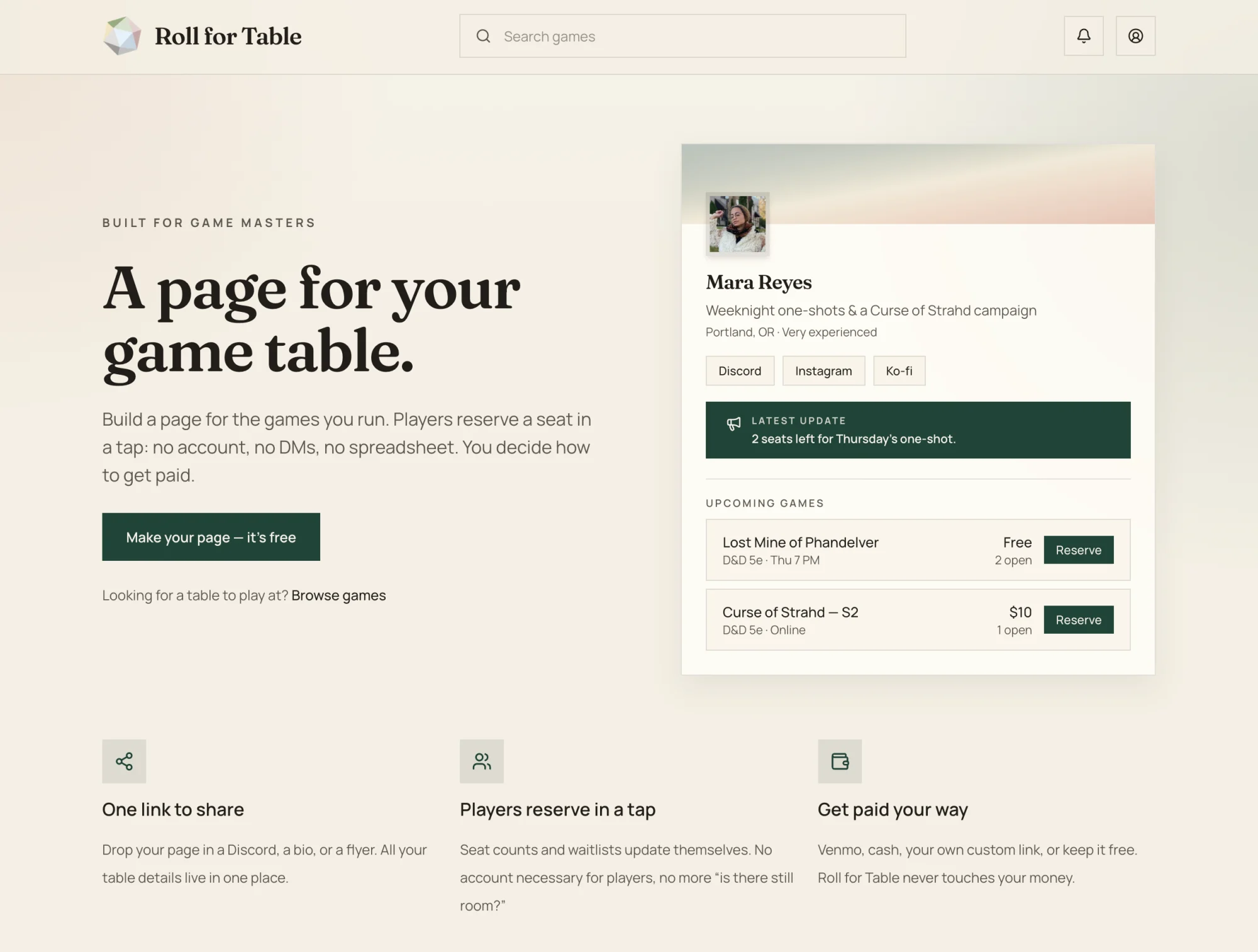
Roll for Table is a page-builder, akin to Carrd or Beacons, made for people who run tabletop games. A game master (GM) lists the games they run, players reserve a seat in a tap (no account, no DMs, no spreadsheet necessary), and the host decides how players are onboarded and how they get paid. The writing uses the hobby’s language, then explains a term when a newcomer might reasonably need help.
The product handles scheduling, seat counts, and payment instructions. The copy also has another job: making sure nobody feels like the only person in the room who has to ask what “one-shot” means or how a reservation works.
Built to lower the barrier
The product copy makes three plain, concrete promises. One link to share: “Drop your page in a Discord, a bio, or a flyer.” Players reserve in a tap: “Seat counts and waitlists update themselves,” and no account is required, so players never hit a sign-up wall. Get paid your way: “Venmo, cash, your own custom link, or keep it free,” followed by the reassuring line, “Roll for Table never touches your money.”
None of those promises are flashy, but they answer the practical questions a GM is likely to have before trusting a new tool with their table.
How it should sound
The product handles the logistics. The voice should make the setup feel familiar and keep new hosts from feeling as if they missed an orientation.
The voice
In tabletop gaming, an open table is a drop-in-friendly game: pull up a chair, no campaign-length commitment, first-timers welcome. “Roll for x” is a common TTRPG phrase, referring to the act of rolling dice to determine various in-game outcomes (roll for initiative, roll for damage, roll for save against poison).
Roll for Table is the seasoned game master at the next table over. It knows the terms and uses them naturally, without turning them into a test. It explains what a newer host may not know, keeps the game references occasional, and stays focused on helping somebody set up a table.
Three rules behind the voice
These principles shape the text of every headline, button, empty state, and error toast before it ships.
1
Fluent
Knows the hobby cold (TTRPGs first, but board games, video games, and geek culture too) and wears it lightly. Reaches for the exact right word in passing (“one-shot,” “session zero,” “waitlist”) the way a GM who’s run a hundred games would. Knowledge is always in service of clarity, though, never a flex.
- Use
- Correct, specific terms, dropped in passing
- Avoid
- Deep cuts as flexing, lore dumps, “if you know, you know”
2
Open table
A good GM makes the first-timer feel like a regular. When a term might trip up a newer host or player, gloss (explain) it the first time it matters, then move on without slowing the veteran down. Lower the barrier, assume curiosity over expertise, gatekeep nothing.
- Use
- A quick inline explanation the first time it matters
- Avoid
- Condescension, assuming everyone’s a veteran
3
In your corner
Straightforward and on your side. Roll for Table wants to help get you set up and is visibly glad to see you do your thing. The enthusiasm is real, but understated; it shows up in the wordplay and the occasional bit of flavor, rather than in jokes or hype.
- Use
- Plain, success-oriented copy; periodic earned bits of flavor
- Avoid
- Hype, exclamation points, forced references on every button
Where the voice sits on NN/g’s four dimensions of tone
The landing page, page builder, and reservation flow all use the same casual, knowledgeable register. It sounds like a GM because it uses the right words in the right places, not because every button contains a joke.
This, but not that
It helps to name the ways this voice could overshoot, since a knowledgeable GM can tip over into a know-it-all pretty easily.
- Knowledgeable, but never showing off.
- Welcoming, but never condescending.
- Fun, but never jokey.
- Encouraging, but never gushing.
Voice in practice: the first thing a host reads
Rejected
“Spin up your campaign hub and manage your TTRPG sessions like a pro GM.”
Chosen
“Build a page for the games you run. Players reserve a seat in a tap: no account, no DMs, no spreadsheet. You decide how to get paid.”
Why: The rejected line leans on jargon (“hub,” “TTRPG”) and flexes a bit with “like a pro.” The chosen line, which is the site’s actual hero copy, uses the plain words a GM would expect, skips the flex, and focuses on the hassle Roll for Table removes rather than selling a fantasy.
Writing the recurring parts
Many components are fields a GM fills while setting up a table. The rules below cover those prompts, along with empty states and errors, where product writing often becomes generic.
| Surface | Roll for Table writes | Not |
|---|---|---|
| Building the page | ||
| Primary CTA | Make your page — it’s free Says exactly what happens and that it costs nothing. | Get started today!, Unlock your GM dashboard |
| Empty state | No games listed yet. Add your first session and players can reserve a seat. Names what goes here, then offers the first concrete action. | It’s quiet in here… |
| First-time gloss | Run a one-shot — a game you wrap in one sitting — or a longer campaign. Explains the term in passing, the first time it matters, without slowing the veteran. | A glossary popup, or assuming everyone already knows |
| Host controls & privacy | You decide who’s approved and what details players see. Puts the GM in charge, in plain terms. | Manage your settings. |
| Publish confirmation | Your table’s set. Here’s your link to drop in a Discord, a bio, or a flyer. One earned bit of flavor, then immediately focus on the useful thing. | Congratulations!! Your awesome page is published! 🎉 |
| When players show up | ||
| Seat & reserve state | 2 seats left · Reserve Honest counts, a plain verb. When it fills: “Full, join the waitlist.” | Seats are going fast, grab your spot now!! 🎲 |
| Error state | That reservation didn’t go through, so your seat isn’t held yet. Try again, or check your connection. Names what happened, provides current status, says what to do. | Oops! Something went wrong 😬 |
| Freed seat | A seat opened up, and the next person on the waitlist is in. Shows the system quietly working on the user’s behalf while concisely explaining a changed status. | “A player has canceled,” or vague phrasing. |
Voice in practice: how you get paid
Rejected
“Host games, get paid.”
Chosen
“Choose how players pay you: Venmo, cash, your own custom link, or keep it free. Roll for Table never touches your money.”
Why: “Host games, get paid” leaves the payment relationship unclear. The chosen copy names the available methods and states the important boundary: Roll for Table never touches the money.
Zoom in: finding a table
Hosts can create games, but those games are a lot less valuable if players can’t find them. Discovery is fundamental to Roll for Table, and it’s where a newcomer is most likely to quietly bail if the experience is confusing or opaque. So the browse page has to pull off the same trick as the GM-oriented materials: fluent enough for someone who knows exactly what they want, but plain enough for someone who has never booked a game in their life.
The “Find a game” page
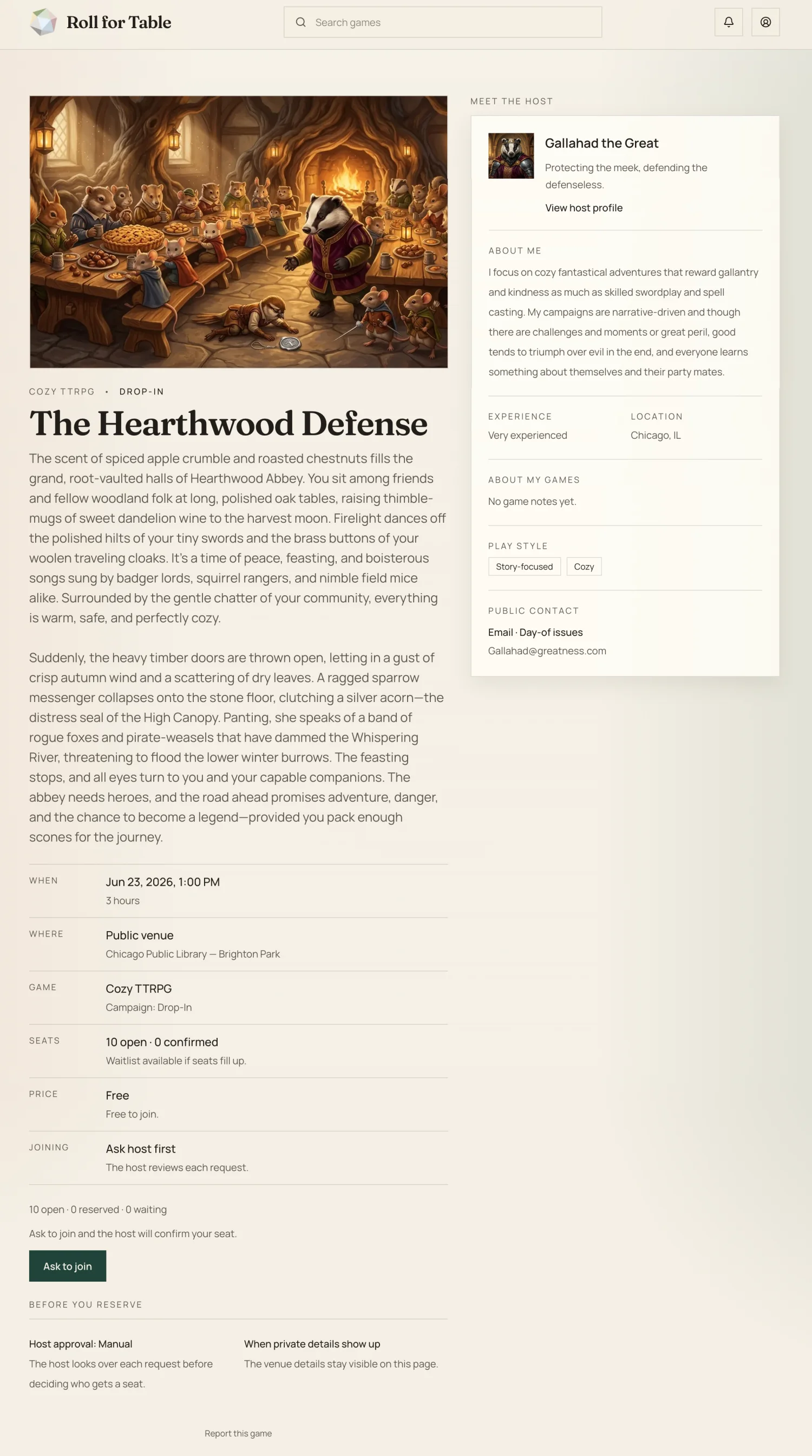
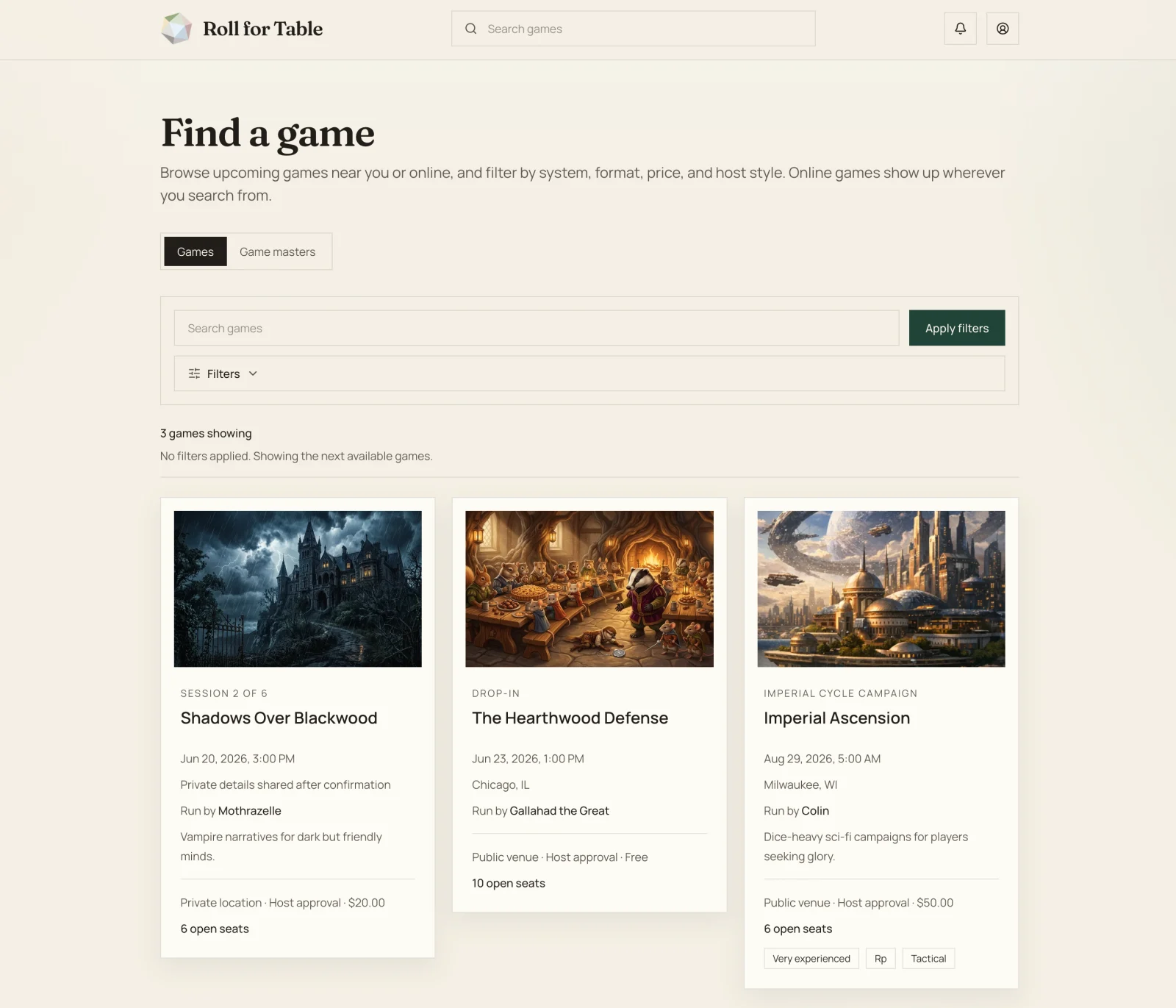
Orient then filter. No jargon is required to help the user figure out what’s happening: “Browse upcoming games near you or online, and filter by system, format, price, and host style.” The next line answers, in plain terms, a question about virtual games a first-timer might never ask out loud: “Online games show up wherever you search from.”
The results stay honest. No fake urgency, just a plain count of what’s actually there (“3 games showing”) and, with nothing selected, “No filters applied. Showing the next available games.” The page never pretends the list is busier than it is.
Cards that scan quickly. Search results emphasize the GM’s name and the number of open seats. The game page then shows the host’s own pitch followed by the date, location, system, price, and seat count. Experienced players can scan it in seconds; newcomers can read straight through and know what they are signing up for.
The host page
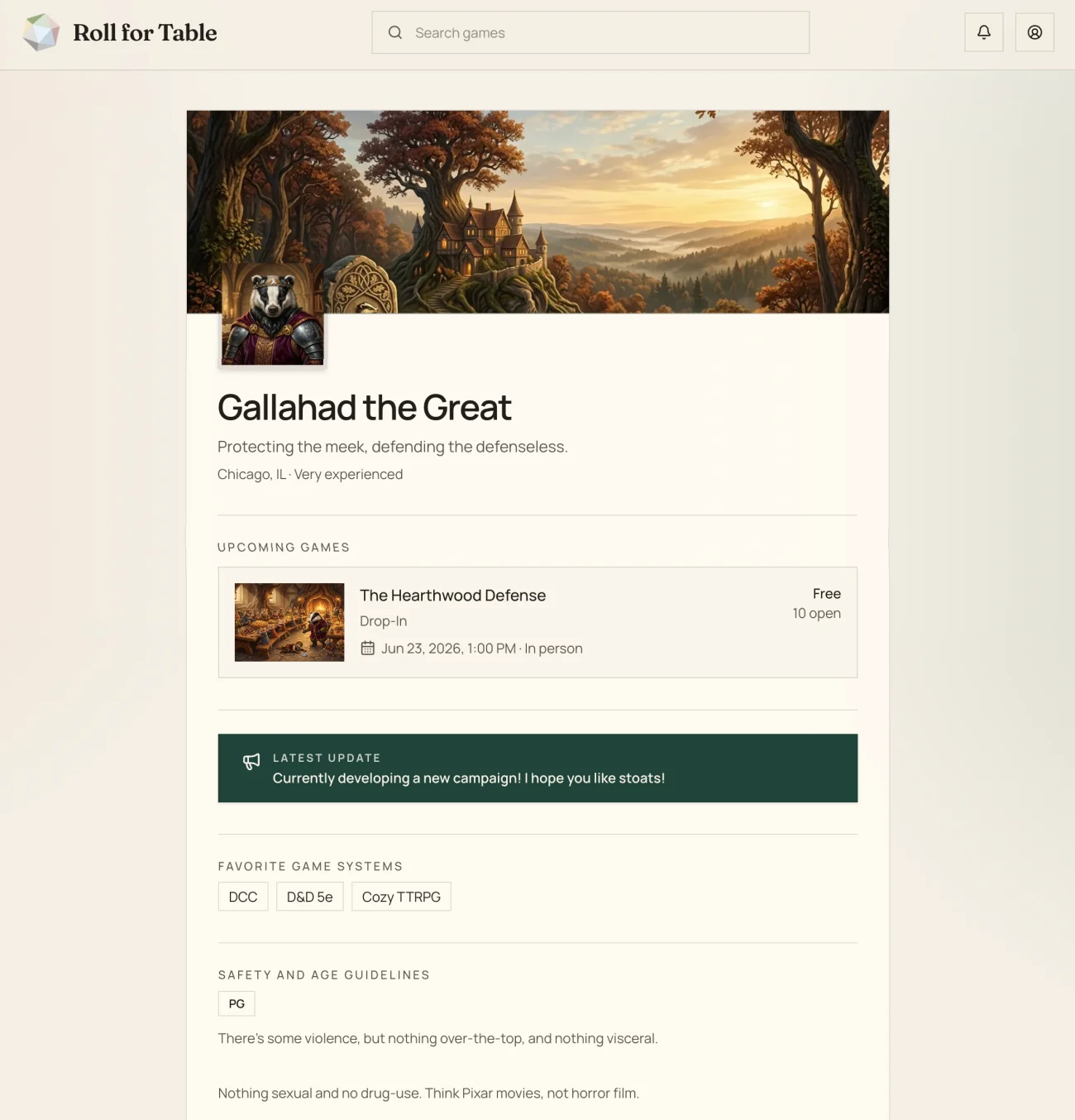
Once a player finds a game, the next question is who is running it. A host can customize the profile to show their personality and style alongside the game calendar.
The bio is one line in the host’s own voice (“Protecting the meek, defending the defenseless.”), the latest-update field reads like a note from a friend (“Currently developing a new campaign! I hope you like stoats!”), and experience and favorite systems are presented as plain, scannable signals: “Very experienced,” “D&D 5e,” “Cozy TTRPG.”
One of the most useful parts of the GM page is the safety section. Instead of a wall of boilerplate language, the host can set and define a content rating in plain words. “There’s some violence, but nothing over-the-top, and nothing visceral. Nothing sexual and no drug-use. Think Pixar movies, not horror film.” A newcomer can tell whether a table is right for them without having to ask, which is a product-wide theme.
Where it stands
Roll for Table is in private testing with a small group of GMs: some veterans who have run tables for years, some hosting their first game. That mix is deliberate: the voice is supposed to work for both groups at once, and testing is where I find out whether it actually does.
The testing is built around three questions. Can a first-time host publish a page without asking for help? Do players reserve a seat without hitting a wall (no account, no DMs, no confusion)? And does any line of copy make a newcomer feel like they’ve walked into someone else’s clubhouse? Every word that causes a tester to hesitate is a writing problem to solve before launch, and several of the lines in this case study are already second or third drafts for exactly that reason.
What the writing has to do
An experienced GM should be able to scan the product without stumbling over beginner explanations. A first-time host should be able to read the same screen without feeling lost. The copy is working when both can set up a game and move on to running it.