Project overview
Editorial
Seventeen years and more than 5,000 editions and episodes, usually published on a deadline.
The operation
What I publish
Since 2009 I’ve published more than 5,000 editions and episodes across a group of long-running and experimental properties. They include Let’s Know Things, a weekly scripted news-analysis podcast with 617 episodes; Brain Lenses, a publication about perception and decision-making with 1,361 essay and audio editions; Aspiring Generalist, a five-times-weekly link-curation newsletter with approximately 1,500 editions; Exile Lifestyle, an essay-centered blog running since 2009; and several other current and former publications. Alongside the periodicals, I’ve published 34 books in nonfiction and fiction.
The subjects and formats vary, but the weekly work is familiar: choose the topic, research it, write and edit on deadline, produce the finished edition, and see how readers or listeners respond. I handle that process myself for each publication.
The process
How a topic becomes an edition
Each publication calls for a slightly different kind of editorial work.
Let’s Know Things is the heaviest lift. I choose a news topic with some staying power, research it through primary sources, and write one continuous explainer that also works when read aloud. The listener should finish with enough context to form their own view.
Brain Lenses uses shorter pieces built around one study or idea about perception. Caveats matter here. Small samples, replication problems, and other limitations need to be clear without swallowing the useful part of the research.
Exile Lifestyle is the loosest and the oldest. It’s a classic blog hosting a weekly essay with no assigned beat, and it covers all sorts of ground, from travel stories to thoughts on relationships and entrepreneurship. Aspiring Generalist is a different kind of editorial filter: I review hundreds of links, select roughly 40 each week, and annotate them for readers. Content Layer, launched in August 2026, gives me a place to examine content strategy, design, voice, and operations directly.
The cadence
Twelve scheduled sends a week
Publishing this many things only works if the week has a predictable structure. Aspiring Generalist sets the base rhythm with five editions. Brain Lenses adds two essays and two audio adaptations. Let’s Know Things, Colin Wright’s Newsletter, and MKE Meetups each add one weekly release. Paid Let’s Know Things and newsletter bonuses run monthly, while Content Layer currently publishes two to four times per month.
That schedule produces approximately 675–700 editions, essays, podcasts, and curated products each year. It also helps me figure out what to research next, when to draft it, and which deadline needs my attention on any given afternoon.
Excerpt 1 · List-style editorial
Adult Friendships
An argument broken into numbered steps.
- It’s often more difficult making friends as adults because we have fewer sources of random serendipity through which we might meet a compatible person.
- We also have more and stronger opinions and preferences as we get older. So while anyone roughly our age would have made for a fine companion when we were five, when we’re adults, our filters are tighter and our tendency to nope our way out of potential friend situations is higher (there are fewer compatible people, because our sense of ‘compatible’ becomes more stringent as we age).
- As we get older, there are also more stresses, strains, responsibilities, and other priorities competing for our time, energy, and resources. As kids, we could go hang out with another kid all day long because that’s what our time was for. As adults, we have our own kids or pets or partners or parents to take care of; we have bills to pay and lower backaches to tend to; we’re worried about politics and the state of the world and the security of our romantic relationships and the stability of our jobs and the size of our retirement funds.
- Those variables have always informed our capacity to initiate and develop friendships, and that’s why community organizations like church groups and social clubs and fraternal organizations like the Freemasons have, for so long, been fundamental to adult socializing. These have been the only reliable means of sparking and cultivating adult relationships outside of work and possibly neighbors for a long time, and thus they’ve been central to how we do things.
- Today, many of those previously leaned-upon access points for friendship have changed, weakened, disappeared, or moved online. The numbers vary depending on where you live, but far fewer people are enthusiastic members of faith-based groups than even a generation ago. Third places where we might meet up with neighbors have been replaced by more commercial spaces, and most of our daily communications with people outside our partners, immediate family, and coworkers have moved online into digital spaces where it’s more difficult to start and stoke real-life relationships.
- Most of the data we have on non-familial, non-romantic relationships between adults in the modern world suggest that regularly bonding over shared interests and spending a lot of time with other people is the most reliable way to develop new friendships. Reading and gaming and knitting and birding and frisbee golf and wine tasting and shuffleboard and foreign language practice meetup groups are all excellent options, especially if they meet (and we attend) regularly, because these groups help us check all those boxes.
- Online spaces can support burgeoning, real-life relationships. Adding a group chat to your shuffleboard club can help you stay in touch between meetups, while also allowing you to discuss other interests, for instance. Even better is inviting some of those people to non-shuffleboard-related activities via this chat, which then gives you another touchpoint over which to bond, and more excuses to connect.
- My mental model for the “friendship recession” plaguing much of the wealthy world right now assumes that the things we used to rely on for sparking and cultivating friendships as we get older are no longer common or reliable, and the new things that have replaced them (like social networks) have been optimized for other purposes, and are now more focused on selling us stuff and gobbling up our attention than connecting us with other human beings. We therefore have to try a lot harder to meet and spend time with other people, because the passive, pre-built relationship infrastructure previous generations relied upon either no longer exists, or no longer serves the same purpose.
Excerpt 2 · Compression
Not the Final Me
A complete arc in about 200 words.
Something that helps me cope with periods of malaise, pain, or discomfort is reminding myself that the me I am today is not the final me.
This is just a version of myself, iterated from previous versions of myself, and every aspect of my being—my life, my career, my relationships, all of it—are prone to revision. That’s how I got to where I am now, and that will continue to happen in the future.
Even as we work toward goals that would change a whole lot about our lives, we tend to imagine ourselves enjoying the fruits of those investments and labors as the same people we are, today. We recall moments from our past, gobsmacked by the choices we made and opportunities we missed, failing to remember that we were different people then, and the things we did (or didn’t do) probably made a lot more sense in the moment, to that earlier iteration.
That means at some point my life will be different from how it is today. I will be different.
My current context shouldn’t feel confining, then, because the me of right now is just a blip on that larger chronological continuum, for better and for worse.
Excerpt 3 · Research translation
Typeface Legibility
A meta-analysis made usable.
A meta-analysis, published as an open-access book in 2022 under the title The Legibility of Serif and Sans Serif Typefaces: Reading from Paper and Reading from Screens, looked at existing literature regarding the relative legibility of different typefaces as presented in different mediums.
Times New Roman is a typeface, while a font is a specific treatment of a typeface, like “Times New Roman, size 14, bold.”
Some typefaces (including Times New Roman) have little lines on their endpoints, and these lines are called serifs. A serif typeface has serifs, a sans-serif typeface (like Arial) does not.
There are other typeface styles that straddle the line between serif and sans-serif, but the primary dichotomy in the English-language typeface world is faces with serifs and those without.
There’s a common belief, based mostly on anecdote, but also a bit of older research, that serif typefaces are easier to read because their shapes are more legible, possibly because the serifs help guide the eye from one character to the next.
It’s also commonly believed that serifed faces tend to be more legible in smaller sizes and on paper, while sans-serifs are more ideal for screens, like those on our phones and laptops.
This meta-analysis found, however, that the majority of existing work in this space demonstrates no difference in legibility between these two typeface categories, and that the research that does seem to show differences between them usually suffers from methodological issues.
It also found that previous research that both holds up and has no major methodological flaws actually indicates that the big difference in terms of legibility and intelligibility is not between serif and sans-serif categories, but between individual typefaces, some of which are just a lot more readable than others (and this seems to be true across all mediums).
Some typefaces have difficult to read lower-case a’s, some have better (in the sense of being easier to parse in different contexts) upper-case D’s, and so on.
Rather than supporting the assertion that serif or sans-serif typefaces will tend to be more intelligible on paper or screens, then, the existing research actually says that there are more and less legible faces in both categories. People who design websites and books should thus use both types if they want to, while avoiding faces with confusing, similar-looking letters when possible (and adjusting the spacing, not the typeface, if they’re optimizing for people with visual impairment or dyslexia).
Excerpt 4 · Complex systems
Circular Finance
A contested financial structure explained neutrally.
One of the big claims about artificial intelligence technologies [...] is that they will serve as universal amplifiers. Electricity is another universal amplifier, in that electrifying systems allows you to get a lot more from pretty much every single thing you do, while also allowing for the creation of entirely new systems. Cooking things in the kitchen? Much easier with electricity. Producing things on an assembly line? The introduction of electricity allows you to add all sorts of robotics, measuring tools, and safety measures that would not have otherwise been available [...]
If you’re the people making AI, if you own these tools, or a share of the income derived from them, that’s a potentially huge pot of money [...] That’s like owning a share of electricity, and making money every time anyone uses electricity for anything.
Through that lens, the big boom in both use of and investment in AI technologies maybe shouldn’t be so surprising. [...]
Belief in that promise is not universal, however. A lot of people see these technologies not as the next electricity, but maybe the next smartphone, or perhaps the next SUV.
The books
Thirty-four titles, in print and audio
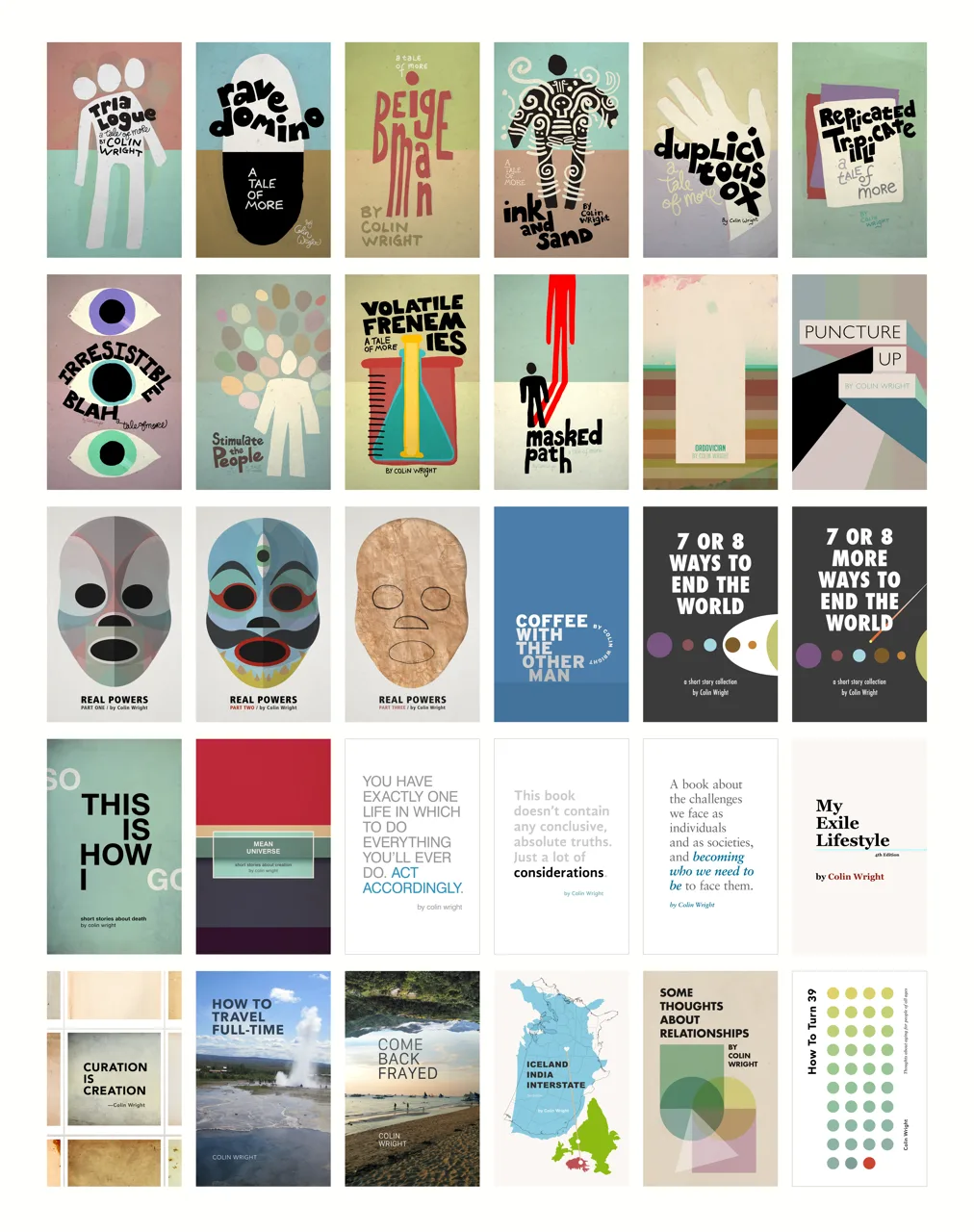
Alongside the periodicals, I’ve written 34 books: 13 nonfiction titles and 21 novels and novellas. I designed, formatted, produced, and narrated all 34, and each is available as an audiobook. The catalog spans travel writing, relationship advice, practical philosophy, and science fiction. The titles have topped multiple Amazon genre categories, including travel, philosophy, and dating books.
Book excerpt 1 · Literary prose
Come Back Frayed
Built on scenes and image-making.
I have a policy about possessions. Several policies, actually, but one of them is that I don’t go to extremes to protect my gear. If something I own can’t survive my lifestyle within the confines of reasonable precaution, it’s better that I know this sooner rather than later. It’s better that we get that gadget-death out of the way, allow that sweater to unravel or those jeans to wear through. Better now than after they become critical to a trip, a linchpin pulled at an uncomfortable moment.
Travel frays. Not just our stuff, but us. It pushes us, rubs us against uncomfortable realities, the friction creating gaps in our self-identity, loosening and then tightening our structure over and over and over again.
It’s an uncomfortable reality, but it’s also the main value proposition of travel. Traveling without being exposed to anything new is like watching a film that’s a bad ripoff of one you’ve already seen. Yes, it may be entertaining, and yes, there’s a certain pleasure that can be derived from a second viewing of a storyline you know you’ll enjoy. But indulging in a familiar plot with familiar characters presented in a customary way seldom leads to learning or self-discovery. There can be joy in rote living, but there probably won’t be growth.
The water here in Boracay is made up of shades of blue I’ve never seen before. Staring out at the ocean I try to count the tones, but they gradate so subtly that I have trouble identifying where a shimmery, crystalline, turquoise-esque green-blue fades into an ice-blue, closer to primary but not as close as the sky, something in the water warping the hues, reshaping them, bending the light in so many ways that accurate description eludes me. The colors, the tones, the tints fade too quickly to be labeled, too rapidly to be limited by words. They cannot be precisely communicated using the iconography of language.
In Mayoyao, the greens were pure, so many tints and shades, each one individually representing the Platonic ideal ‘green’ if viewed in isolation. They blended pleasantly, interrupted here and there by browns and other literal earth-tones, mud when there had been rain, fluffy, hazy grays in the sky, sometimes sinking down over the mountains into the valleys, kissing the mirrored surfaces of the rice terraces, their segmented, faultless faces reflecting the mood of whatever was around them, like a skilled conversationalist in a crowd of emotional networkers. There were rust reds and pebble whites there, opalescent grays and rosy pinks. But here there are just the blues, underlined by the sunblasted beige of the sand.
Book excerpt 2 · Frameworks
Some Thoughts About Relationships
A named, reusable framework applied to a soft subject.
From a very young age, many of us are told stories about The One: a mystical person who is placed on this planet for us and us alone. It’s our “hero’s journey” to find this individual, wherever they may be. If pop culture is to be believed, there will be a series of comedic situations and dramatic adventures that lead up to our finding them.
In real life, however, The One is a concept that isn’t just irrational, it’s potentially harmful. The idea that there’s someone out there who is customized to make you whole implies that you’re not capable of being complete on your own. It also implies that everyone other than The One is just a stepping-stone toward grand fulfillment, which is a horrible way to approach relationships.
It’s understandable why this is such a popular storyline. Who doesn’t want to be the hero of the story? Who doesn’t want to believe that the imperfections we see in ourselves, and the bad hair days we experience, are just the buildup toward relationship bliss?
The concept of The One actually shares the same history as the concept of a “soul mate,” which comes from a tale written by Aristophanes, a comic playwright and contemporary of Plato. In this particular story, two-headed giants — some with both male and female genitalia, some with two sets of male equipment, and some with pairs of female parts — were sliced down the middle by a jealous Zeus and scattered to the wind. They were doomed forever after to explore the planet, seeking their “other half.”
As a metaphor, I get it. And the “soul mate” feeling is one I think most of us are familiar with. That vibe you get from someone who resonates with you is a connection that can be difficult to explain. It’s the sum of a huge collection of variables, mental and physical attraction key among them, which add up to something that feels almost metaphysical. It’s wonderful and memorable and often more than a little distracting.
To me, reducing something so remarkable to something as kitschy as “magic” or “fate” is borderline offensive. Those feelings are valuable; experiencing them can catalyze some of the most wonderful moments of our lives, and we’re supposed to just say, “yeah, it was bound to happen sooner or later”? Why not just celebrate the wonderful coincidences and randomness that brought such a person into your life, instead?
No, it’s not magic. And it’s not something that can only happen once. Recognizing the shallowness of The One complex allows us to see that we’re capable of loving more than a single person in our lifetime.
This is the crux of The One Policy. Why should we limit ourselves when we could be happier more of the time? Why should we be fated to endlessly pursue a fairy tale, when potential sources of actual emotional interaction and enjoyment are all around us? Why do we romanticize an idea that couldn’t be further from actual romance? An idea that keeps us from experiencing fulfillment, and which forces us to wonder about the legitimacy of our connections with other people when we’re fortunate enough to find them?
You are The One. You are the only person in the world who can complete and fulfill you, and ensure your happiness. Everyone else is a potential, hopefully wonderful, addition to that fated situation. You are born complete, you die complete, and you decide whom you spend your time with in between.
Outcomes
Seventeen years and counting
I’ve been publishing independently for seventeen years, and have produced more than 5,000 editions and episodes across newsletters, podcasts, books, and the web in that time. The business is reader-supported, which means missed deadlines and wasted attention have a real, immediate cost (and it also means the audience numbers above represent people who’ve chosen to stick around, and in some cases pay to do so).